AMD Instinct MI350X vs. MI355X: Key Differences, Specs, and TCO Analysis
AMD Instinct MI350X vs MI355X at a Glance
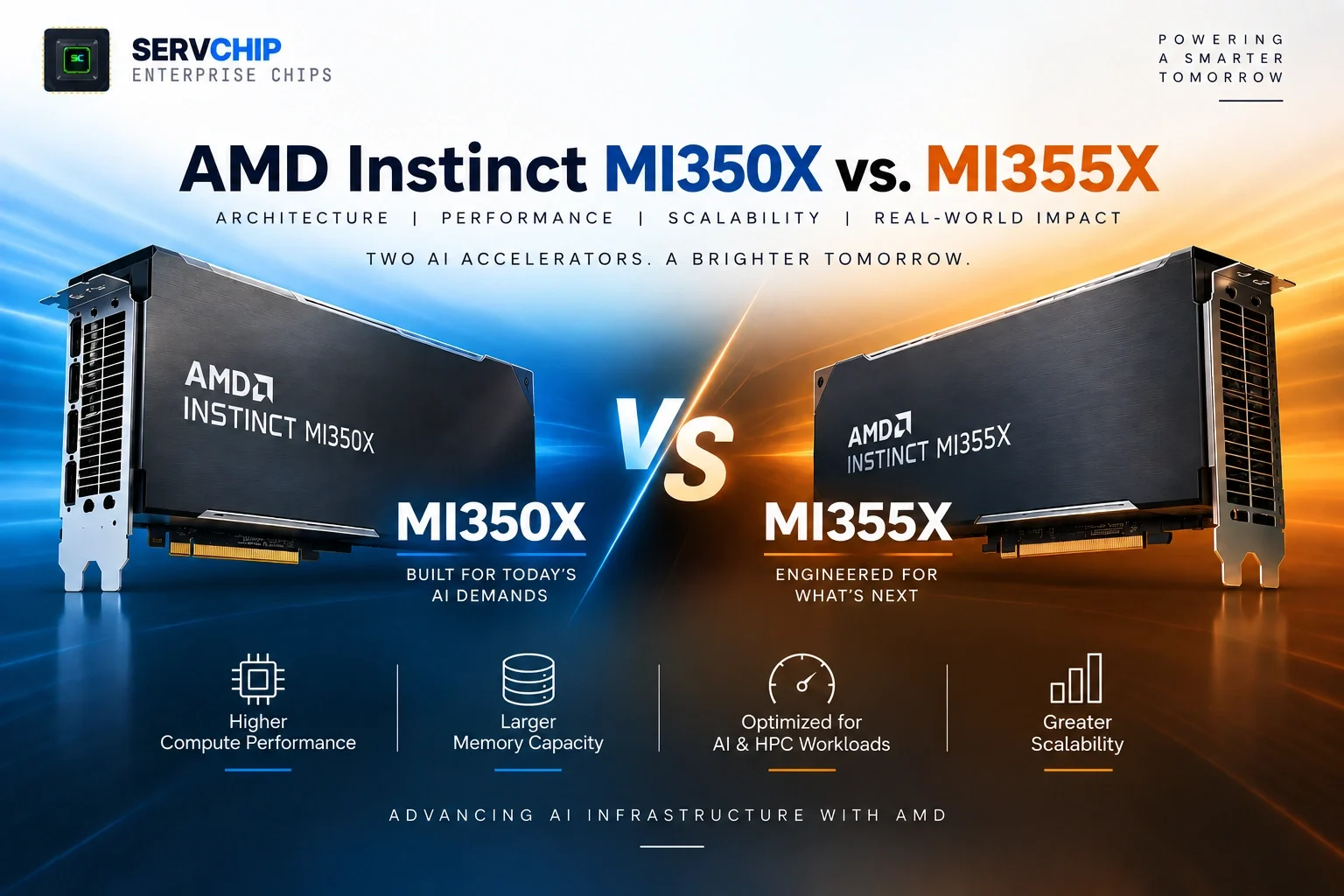
The fundamental difference between the AMD Instinct MI350X and MI355X comes down to power consumption, thermal management, and clock speeds. Both GPUs share AMD's 3nm CDNA 4 architecture, an identical 288GB HBM3e memory pool, and 8.0 TB/s of memory bandwidth.
The AMD Instinct MI350X Accelerator runs at a 1,000W TDP, built for traditional air-cooled enterprise data centers. The MI355X scales up to 1,400W TDP and requires direct-to-chip liquid cooling, but in exchange delivers up to 10% higher peak compute performance (~5.03 PFLOPS vs. ~4.61 PFLOPS dense FP8).
Short on time? The spec matrix below puts both parts side by side, and the final verdict picks one per facility type. For the full silicon breakdown of the air-cooled part, read our AMD Instinct MI350X GPU deep dive.
Architectural Overview: The CDNA 4 Foundation
Both the MI350X and MI355X represent AMD's competitive push against the NVIDIA Grace Blackwell Superchip (GB200). Transitioning from CDNA 3 to CDNA 4 on TSMC's 3nm process node brings significant architectural enhancements aimed at large language models (LLMs) and generative AI workloads:
- Native Low-Precision Formats: Full hardware support for FP4 and FP6, doubling matrix math efficiency over legacy FP8 and FP16 formats.
- Unified Memory Footprint: 288GB of ultra-fast HBM3e memory across 8 stacks, eliminating memory bottleneck constraints during multi-billion parameter model execution.
- Infinity Fabric Interconnect: Next-generation scale-out bandwidth operating at up to 1,075 GB/s bi-directional links per GPU.
Rather than forcing a single thermal profile across all data center layouts, AMD engineered two physical variants to accommodate different data center enterprise solutions and cooling limits.
AMD MI350X and MI355X AI GPUs Spec Comparison
When reviewing the hardware matrix, the shared memory subsystem ensures model capacity parity, while the power envelope dictates maximum compute throughput.
| Feature / Metric | AMD Instinct MI350X | AMD Instinct MI355X |
|---|---|---|
| Architecture | CDNA 4 (3nm) | CDNA 4 (3nm) |
| VRAM Capacity | 288GB HBM3e | 288GB HBM3e |
| Memory Bandwidth | 8.0 TB/s | 8.0 TB/s |
| Thermal Design Power (TDP) | 1,000W (Air-Cooled Target) | 1,400W (Liquid-Cooled Target) |
| Cooling Requirement | Standard Air / Facility Fluid | Direct Liquid Cooling (DLC) |
| Peak FP8 (Dense) | ~4,614 TFLOPS | ~5,033 TFLOPS |
| Peak FP16 (Dense) | ~4.61 PFLOPS | ~5.03 PFLOPS |
| Peak FP4 (Sparse) | ~18.4 PFLOPS | ~20.1 PFLOPS |
| Interconnect Bandwidth | 1,075 GB/s Infinity Fabric | 1,075 GB/s Infinity Fabric |
Read across any row other than power and cooling and the two parts are effectively twins: same process node, same memory capacity, same bandwidth, same fabric. The 400W of extra headroom on the MI355X is the only lever AMD pulls to separate the two SKUs.
AMD MI350X and MI355X AI GPUs Review: Performance and Infrastructure Fit
1. Compute Density vs. Power Headroom
The 400W additional power allowance in the MI355X gives AMD the headroom to drive higher base and boost clocks across its Compute Units. In training clusters running distributed FP8 or FP4 matrix multiplications, the MI355X reduces wall-clock execution time by roughly 8% to 10%.
For memory-bound inference, however, the real-world gap narrows significantly. Before deciding on multi-GPU deployments, you can use our GPU Calculator for LLM Training to calculate exact VRAM requirements. Because both GPUs share the same 8.0 TB/s memory bus and 288GB footprint, key-value (KV) caching capacity and batch size limits remain identical.
2. Air Cooling vs. Direct Liquid Cooling (DLC)
MI350X (1,000W): Engineered to integrate into legacy enterprise racks. It allows organizations to deploy state-of-the-art CDNA 4 hardware without re-engineering facility plumbing or investing in expensive Coolant Distribution Units (CDUs).
MI355X (1,400W): Designed exclusively for modern high-density environments. At 1.4 kW per socket, standard air cooling is physically unviable; deployment requires direct-to-chip liquid loops, manifold connections, and dedicated heat exchange systems.
AMD MI350X and MI355X AI GPUs Price and TCO Considerations
Evaluating the AMD MI350X and MI355X AI GPUs price structure requires looking beyond raw OEM silicon costs to total operational expenditure (TCO). On the software stack side, both GPUs leverage ROCm vs CUDA compatibility to ensure seamless software deployment.
Hardware & Retrofit Costs
While contract pricing for enterprise 8-GPU node systems varies by vendor (e.g., Dell, HPE, Supermicro), total deployment cost differs substantially:
- MI350X Systems: Lower overall deployment cost. Standard chassis designs lower upfront rack integration expenses and eliminate liquid loop maintenance routines.
- MI355X Systems: Higher capital expenditure (CapEx). Facilities must budget for fluid management, CDU infrastructure, leak detection monitoring, and higher power delivery per rack.
Cloud On-Demand Rates
On major hyperscaler and cloud GPU networks, instance pricing reflects this infrastructure tax. For more guidance on hardware procurement, consult our GPU Buying Guide:
- MI350X Instances: Typically range from $3.50 to $5.50 per GPU/hour, offering a cost-effective sweet spot for fine-tuning, mid-tier training, and standard model serving.
- MI355X Instances: Command premium rates ranging from $5.00 to $8.00+ per GPU/hour, targeted at enterprise workloads where time-to-convergence takes absolute priority.
Cloud and OEM prices move weekly with supply and export policy changes. Treat every figure above as indicative, validate it against a live quote request, and compare current availability before locking a procurement plan.
Final Verdict: Which GPU Fits Your Infrastructure?
Select the AMD Instinct MI350X if: You operate within traditional air-cooled facilities, seek to minimize rack retrofit CapEx, or primarily host large-model inference workloads that rely heavily on memory bandwidth rather than peak TFLOPS. Check the full AMD GPU Enterprise Catalog for specific accelerator models.
Select the AMD Instinct MI355X if: Your data center features direct liquid cooling infrastructure, and your goal is maximizing FLOPS-per-square-foot for massive LLM training runs.
Both accelerators are the same silicon wearing two different thermal budgets, so the decision is really an infrastructure decision. If you are still sizing the cluster, read how many GPUs you actually need for LLM training first, then request a quote and we will price the configuration your facility can actually cool.
Frequently Asked Questions (FAQ)
What is the primary difference between the AMD Instinct MI350X and MI355X?
Power and cooling. Both share the same CDNA 4 architecture, 288GB HBM3e memory and 8.0 TB/s bandwidth, but the MI350X runs at a 1,000W TDP for air-cooled racks while the MI355X runs at 1,400W and requires direct-to-chip liquid cooling.
Do the MI350X and MI355X use the same memory configuration?
Yes. Both ship 288GB of HBM3e across 8 stacks with 8.0 TB/s of memory bandwidth, so model capacity, KV-cache sizing and batch limits are identical on either part.
Does the AMD Instinct MI355X require liquid cooling?
Yes. At 1,400W per socket, standard air cooling is not viable for the MI355X - it needs direct-to-chip liquid loops, manifolds and CDU infrastructure. The 1,000W MI350X, by contrast, drops into conventional air-cooled enterprise racks.
How much faster is the MI355X than the MI350X?
Roughly 8% to 10% in compute-bound training. Peak dense FP8 rises from about 4,614 TFLOPS to 5,033 TFLOPS (about 4.61 to 5.03 PFLOPS), while memory-bound inference workloads see a much smaller gap because both parts share the same memory subsystem.
Which has the lower total cost of ownership?
The MI350X usually wins on TCO: no liquid loop retrofit, no CDU infrastructure and lower rack power delivery costs, plus cheaper on-demand cloud rates. The MI355X costs more up front but can be cheaper per FLOP when rack space and time-to-convergence are the binding constraints.
Where can I buy the MI350X or MI355X?
Servchip distributes both AMD Instinct accelerators with authentic sourcing, warranty and global delivery. Request a quote for current pricing, configuration options and lead times.
Servchip global availability
Enterprise NVIDIA, AMD and Intel hardware is available through Servchip across these regions. Browse local availability, delivery details and region-specific sourcing:


Related Products
Browse chips and systems mentioned in this article
Related Articles
Continue exploring our technical library
AMD Instinct MI350X GPU: Specs, CDNA 4 & AI Performance
A deep dive into the AMD Instinct MI350X: CDNA 4 architecture, 288 GB HBM3e memory, 8 TB/s bandwidth, native MXFP4 support and ROCm 7.0 for AI training and HPC workloads.
NVIDIA H100 vs AMD MI300X: Which AI GPU Should You Choose in 2026?
NVIDIA H100 vs AMD MI300X compared on memory, bandwidth, FP16 compute, software ecosystem and price. A neutral spec and use-case comparison to help you choose the right AI accelerator.
ROCm vs CUDA: AMD vs NVIDIA AI Stack Compared (2026)
ROCm vs CUDA in 2026: real benchmarks, cloud pricing, framework compatibility, and a step-by-step migration guide to help you choose the right AI stack.