NVIDIA Grace Blackwell Superchip (GB200): Architecture, Specs & Use Cases
A New Class of AI Superchip
Every few years, a single piece of hardware changes what enterprise AI teams believe is achievable. For Servchip, the NVIDIA Grace Blackwell Superchip represents that shift for 2026.
It is not simply a quicker GPU. It is a tightly integrated CPU and dual-GPU module engineered to remove the bottlenecks that slow trillion-parameter training and real-time inference at rack scale. At the core of this system, the GB200 Grace Blackwell Superchip uses a 900 GB/s NVLink-C2C interconnect to seamlessly link one Grace CPU with two high-efficiency Blackwell GPUs.
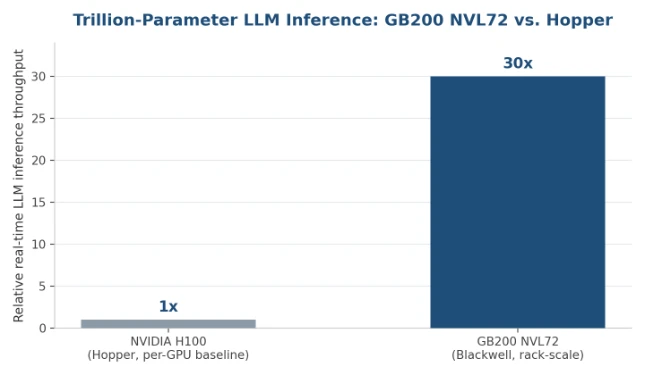
When deployed at scale, the liquid-cooled NVIDIA GB200 NVL72 architecture unites 36 Grace CPUs and 72 Blackwell GPUs into a single, unified NVLink domain. Functioning as a massive computing engine, it delivers up to 30 times faster real-time inference for trillion-parameter large language models while supercharging data processing and high-performance computing.
For CTOs and data center operators partnering with Servchip to plan their next AI infrastructure cycle, understanding the GB200 Grace Blackwell Superchip, and how it departs from the Hopper generation before it, has become a procurement decision as much as an engineering one.
The GB200 Grace Blackwell Superchip places one NVIDIA Grace CPU alongside two NVIDIA Blackwell GPUs on a single board. A 900 GB/s NVLink-C2C link ties the three dies together in a fully cache-coherent design.
In practice, this means the CPU and both GPUs draw from one shared memory space instead of moving data back and forth across PCIe. Each Blackwell GPU is itself built from two reticle-sized dies fused into a single unit, linked internally at 10 TB/s.
The GPU carries roughly 208 billion transistors and is fabricated on a custom TSMC 4NP process. With up to 384 GB of HBM3e memory running at close to 16 TB/s, the superchip is built to hold enormous model weights in fast memory rather than waiting on slower interconnects.
Quick answer: The GB200 Grace Blackwell Superchip connects a Grace CPU and two Blackwell GPUs over a 900 GB/s NVLink-C2C link, creating one coherent memory domain for large-scale AI workloads.
Second Generation Transformer Engine
The second-generation Transformer Engine is where the architecture actually pays off for training and inference. It introduces new microscaling formats and FP4 precision on top of the FP8 path Hopper already used, packing more math into each cycle without sacrificing accuracy.
Paired with fifth-generation NVLink, NVIDIA rates this engine at up to 4x faster large language model training and up to 30x faster real-time inference on trillion-parameter models at the GB200 NVL72 rack level, measured against a comparable Hopper cluster.
The gain is sharper still for teams running mixture-of-experts architectures, since MoE inference leans heavily on fast token routing between GPUs, exactly what the combined engine and NVLink fabric are designed to speed up.
Performant Confidential Computing and Secure AI
Enterprises moving proprietary models and customer data onto shared or hybrid AI infrastructure need protection that goes beyond encryption at rest. Blackwell extends NVIDIA Confidential Computing down to the GPU itself.
Model weights and inference data stay protected while actively in use, with native encryption running between the CPU, GPU, and NVLink fabric. Historically, this level of protection has come at a performance cost.
On Blackwell, the protected mode runs without a meaningful throughput penalty, which matters most for healthcare, financial services, and government-adjacent workloads across the UAE and South Asia, where data residency and model confidentiality are procurement requirements rather than preferences.
Fifth-Generation NVLink
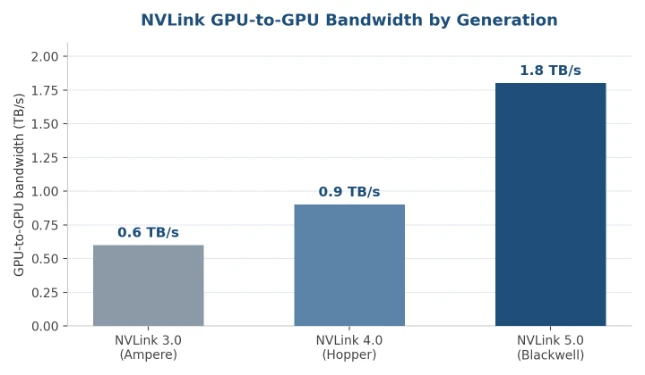
NVLink is the piece that lets NVIDIA GPUs work as one logical accelerator instead of a rack of separate cards. Fifth-generation NVLink raises GPU-to-GPU bandwidth to 1.8 TB/s per GPU, roughly double the prior generation.
At rack scale, the GB200 NVL72 uses this fabric to link 72 Blackwell GPUs into one NVLink domain, moving around 130 TB/s of aggregate GPU-to-GPU bandwidth.
The practical effect is that the rack behaves like one very large processor instead of 72 separate ones. Without this faster fabric, the second-generation Transformer Engine would run out of bandwidth trying to keep 72 GPUs in sync on the same model.
Decompression Engine
Not every enterprise workload is a training run. A large share of data center budgets still goes toward data preparation, database queries, and analytics pipelines that have traditionally run on CPU-only infrastructure.
Blackwell adds a dedicated decompression engine that offloads common compression formats directly to hardware, working alongside libraries such as Spark RAPIDS to speed up query and join operations.
NVIDIA reports up to 18x faster database query performance versus CPU-only systems, and roughly 5x better total cost of ownership for analytics workloads running on GB200 infrastructure instead of an equivalent CPU-bound cluster.
Use Cases and Workloads
In practice, the GB200 Grace Blackwell Superchip is being deployed across a fairly consistent set of workloads:
- Training and fine-tuning of trillion-parameter and mixture-of-experts large language models
- Real-time, high-concurrency LLM inference for production AI applications and agentic systems
- Confidential AI inference for healthcare, banking, and government workloads with strict data-handling requirements
- GPU-accelerated data analytics, ETL, and database operations using the built-in decompression engine
- Digital twin and scientific computing simulations that benefit from unified CPU-GPU memory
- Sovereign and regional AI cluster builds across the Middle East and South Asia, where compute is being localized rather than consumed purely through hyperscale cloud
For most enterprise buyers, the real question is less about the architecture itself and more about getting genuine GB200 and GB200 NVL72 capacity allocated, configured, and delivered on a workable timeline. Request a GB200 quote or explore our GPU solutions with our team.
Servchip global availability
Enterprise NVIDIA, AMD and Intel hardware is available through Servchip across these regions. Browse local availability, delivery details and region-specific sourcing:
Related Products
Browse chips and systems mentioned in this article
Related Articles
Continue exploring our technical library
AI Chip Market Trends 2026: NVIDIA, AMD, Intel, and Beyond
AI chip market trends 2026: NVIDIA, AMD, and Intel stock moves, semiconductor market forecasts, and what's next for the industry through 2030.
GPU Buying Guide 2026: How to Choose the Right AI Accelerator
Buying a GPU for AI in 2026 isn't as simple as picking the card with the biggest number on the box. This guide breaks down exactly how to think about the decision so you don't overspend or under-buy.
How Many GPUs Do You Need for LLM Training? Complete Calculator (2026)
Calculate exactly how many GPUs you need for LLM training. Free interactive GPU calculator, VRAM formulas, real-world examples for 7B to 175B models, and hardware recommendations for any budget.